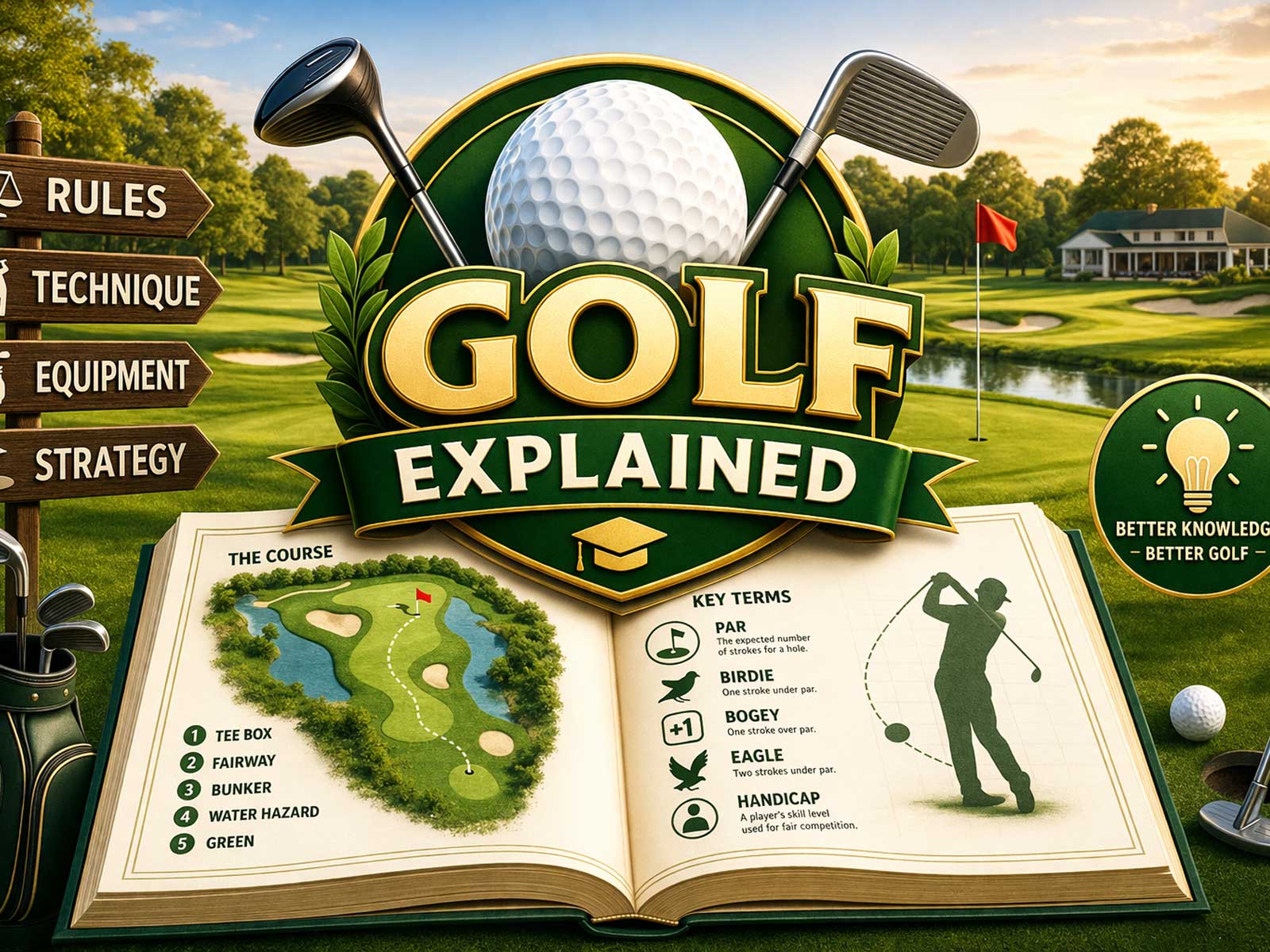
Golf Terms Explained: A Beginner’s Guide to Par, Birdie, Bogey and More
Golf has its own compact language. Knowing basic terms — from par and birdie to fairway, bunker and putt — helps new players follow a round, improves decisions on the course, and even makes vintage golf posters and clubhouse prints more meaningful. This guide defines the essentials and explains how they affect scoring, shot choice and course strategy.
Quick summary: Par is the expected strokes for a hole; birdie, eagle and bogey show scores relative to par. Course features like fairway, rough, green and bunker shape strategy. Short shots — chip and putt — and long shots — the drive — determine scorecard entries.
Quick access: Definition · Scoring & scorecards · Course features
CLEAR DEFINITION
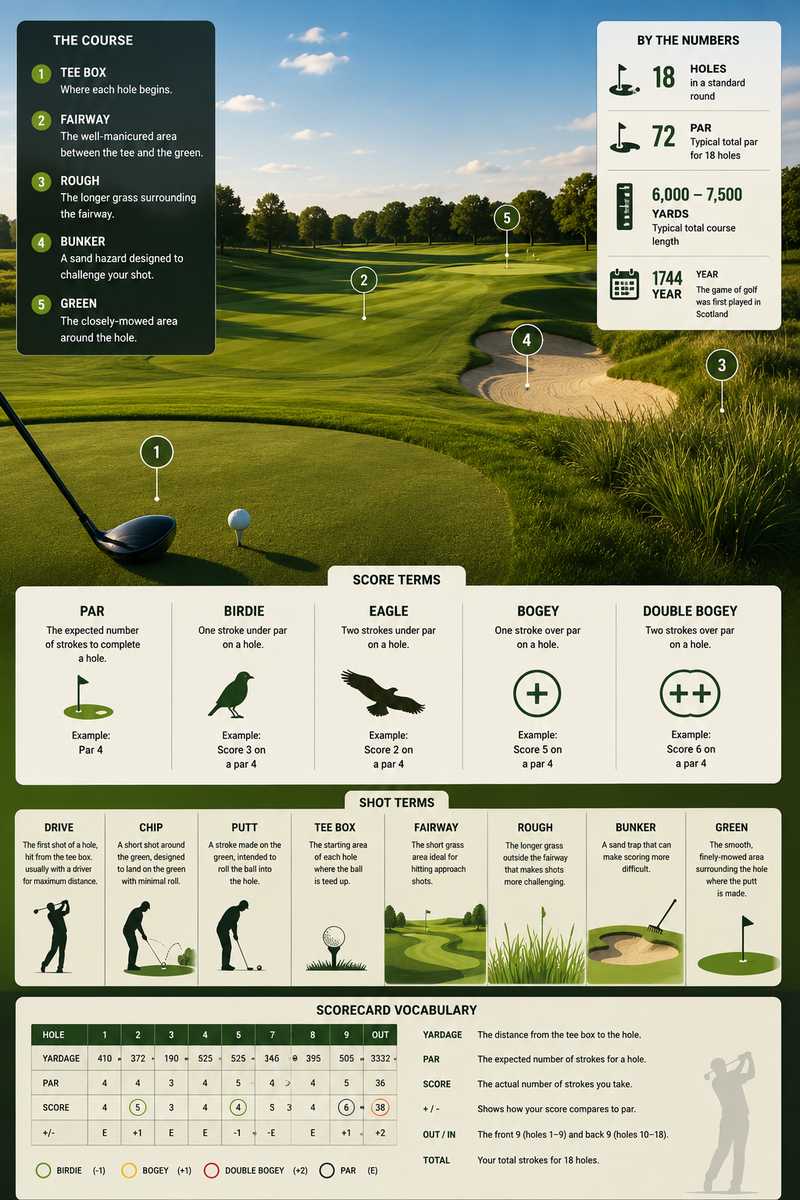
Par is the number of strokes an expert (scratch) golfer is expected to take to complete a hole. Holes are commonly par-3, par-4 or par-5 and the par for a round is the sum of each hole's par values. Terms that describe scores relative to par include birdie (one under), eagle (two under) and bogey (one over). An albatross or double eagle is three under, but that term is less common.
SCORING AND SCORECARDS
Scorecards list each hole’s par and record a player’s strokes. Players and scorekeepers often note results relative to par using plus and minus figures (for example −1 for one under or +2 for two over). Typical notations on a card also include birdie, bogey, eagle and hole-in-one (ace); totals are usually shown for the front nine, back nine and the full 18-hole round.
COURSE ARCHITECTURE AND STRATEGY
Fairway refers to the closely mown strip between tee box and green that is the intended landing area for most tee shots; hitting the fairway often leaves a simpler next shot. Rough is the longer, coarser grass bordering fairways and greens and is intended to penalize inaccurate shots by making contact and control harder. Designers place bunkers—sand-filled hazards—on or near fairways and greens to influence where players aim and which clubs they choose.
SHOT TYPES AND CLUBS
Drive generally means the long first stroke from the tee box, often played with a driver or a wood to gain maximum distance down the fairway. A chip is a short, low-trajectory shot played from close to the green or fringe aimed at quickly getting the ball onto the putting surface and stopping it near the hole. A putt is the smooth, controlled stroke played on the green (or very near it) with a putter to roll the ball into the hole.
HOW THESE TERMS AFFECT PLAY
Understanding par and the relative-score terms matters for strategy: on a par-4 a conservative player may aim for a fairway position to secure par, while an aggressive line might chase a birdie but risk rough or bunkers. Short-game competence—chipping and putting—often decides whether a player converts an approach into a birdie or settles for a bogey. Course features and pin position change club selection and shot shape choices throughout a round.
COMMON MISUNDERSTANDINGS
Beginners sometimes confuse the words: birdie is not any good shot, it specifically means one stroke under par on a hole. Eagle is two under; an albatross (three under) is rare. Another common point is that the tee box is the area where play of a hole begins, not the tee peg itself. Finally, a bunker is a sand hazard—sometimes called a sand trap—but play from a bunker follows the same scoring concept: strokes count toward the hole total.
READER VIEWING GUIDE & GOLF ART
On broadcasts or when reading a leaderboard, look for relative-to-par notation to quickly judge how a round is going rather than raw totals. For fans who love golf posters and clubhouse art, these terms help decode imagery: a poster showing a sweeping fairway with a distant green speaks to strategy and drive placement; a close-up of a putting green celebrates the skill of the putt and the tactile quality of a clubhouse print. Vintage prints often emphasize the line from tee box to green—the geography that makes par and scoring meaningful.
CLOSING INTERPRETATION
These basic terms—par, birdie, eagle, bogey, fairway, rough, green, bunker, tee box, drive, chip and putt—form the vocabulary of every round. They explain how scores are recorded on a scorecard and how course design forces choices. Learning them makes a walk of 18 holes easier to read, improves decision-making, and deepens appreciation for the visual stories found in golf art and clubhouse decor.
Author: Cynthia D.